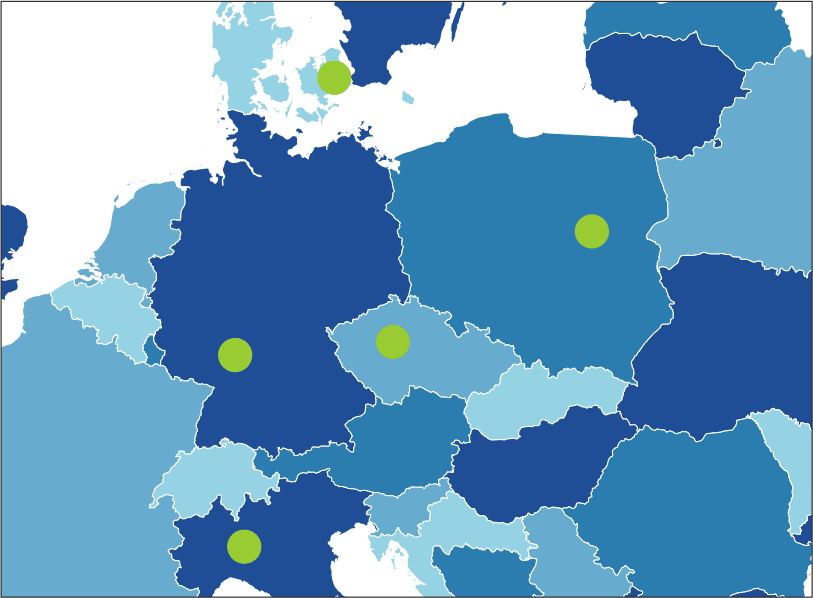

Environmental Economics and Policy Joint Programme
1st year (60 ECTS) – Foundation
2nd year (60 ECTS) – Specialisation
What is the European Credit Transfer and Accumulation System (ECTS)
Overview of programme structure
University of Copenhagen
Environmental Economics and Policy in Europe
Heidelberg University, Alfred Weber Institute for Economics
Advanced Environmental Economics
Heidelberg University, Institute of Politicial Science
Comparative Environmental Policy
The 2nd year programme in Comparative Environmental Policy at Heidelberg offers a specialization in the theory-led empirical assessment of the characteristics and drivers of environmental policy in Europe. The first term features a fixed set of three compulsory courses, amounting to 24 ECTS, and a restrictive elective course of 6 ECTS. The second term features the Master’s thesis (27 ECTS) and the joint thesis and employment workshop (3 ECTS).
|
Semester 1 |
Semester 2 |
|
*(if needed for list of restricted electives) |
|
|
Restricted elective subject elements (6 ECTS) To be covered as subject elements from the following list:
|
Compulsory courses:
To obtain 8 ECTS, the student will have to give an oral presentation (2 ECTS) and prepare a term paper of 5,000 words (6 ECTS). The oral presentation will be given during the course. The due date for the term paper is March 15.
Comparative Environmental Policy
Environmental policy encompasses all policy instruments designed to address environmental challenges. While these instruments can be categorized using universal frameworks (such as the NATO scheme, which distinguishes between nodality-, authority-, treasure-, and organization-based systems), their implementation and calibration vary across jurisdictions. This course introduces students to both conceptual classification systems for environmental policy instruments and their practical application in European Union (EU) member states. Students will also examine the domestic (e.g., political party preferences) and international factors (e.g., EU directives and international environmental agreements) that influence the selection and calibration of environmental policy instruments.
To obtain 8 ECTS, students have to achieve a minimum grade of 4,0.
Methods in Comparative Political Science
Political science employs a diverse array of empirical methods to systematically compare political institutions (polities), processes (politics), and outcomes (policies) both within countries (e.g., at subnational, provincial, or regional levels) and across nations. These methods serve to explain differences and similarities between observation units and enable researchers to identify trends, patterns, and regularities among them. This course introduces students to case-study design methods for comparative empirical research, including most-similar-systems and most-different-systems designs. Additionally, students will learn statistical techniques for analyzing cross-sectional, longitudinal, and time-series-cross-sectional data.
To obtain 8 ECTS, students have to achieve a minimum grade of 4,0.
Policy Design and Practice
Policy theories provide comprehensive insights into policy processes across diverse settings. This course teaches students how to effectively communicate these theoretical insights to broader audiences. Students will first explore leading policy process theories (such as the Advocacy Coalition Framework). They will then examine the distinction between policy scholars serving as ‘knowledge brokers’ versus ‘policy advocates’. The course will also teach techniques for presenting research findings in clear, accessible language, avoiding jargon and unnecessary complexity to enhance their potential impact. Finally, students will critically examine the actual and potential roles of policy studies and scholars in shaping public policy design and implementation.
To obtain 8 ECTS, students have to achieve a minimum grade of 4,0.
Elective courses:
To obtain 6 ECTS, the student will have to prepare a term paper of 5,000 words.
Performance of Democracies and Autocracies
This course examines the distinctive characteristics of democratic and autocratic regimes, exploring their operational mechanisms and analyzing the policy outputs and outcomes they generate.
To obtain 6 ECTS, students have to achieve a minimum grade of 4,0.
Theories of Public Policy
This course provides an introduction to fundamental theories of public policymaking. While focusing primarily on policy process theories, it also incorporates complementary theoretical frameworks that examine specific explanatory factors, such as the influence of political parties on policy outputs.
To obtain 6 ECTS, students have to achieve a minimum grade of 4,0.
Environmental Justice: discourses, concepts and theories in comparison
This course, situated within modern political theory, explores theories of justice and their application to contemporary environmental challenges.
To obtain 6 ECTS, students have to achieve a minimum grade of 4,0.
International Comparative Climate Policy
This course examines the landscape of national climate policies and introduces students to relevant policy databases, evaluating their utility for different research approaches.
To obtain 6 ECTS, students have to achieve a minimum grade of 4,0.
Comparative Conflict Analysis
This course explores the fundamental characteristics of conflicts and the conditions that lead to war. Students will develop a nuanced understanding of conflict dynamics and manifestations, examining both de-escalation pathways and factors that drive conflict escalation.
To obtain 6 ECTS, students have to achieve a minimum grade of 4,0.
Comparative Public Policy
While all governments produce public policies, these policies vary across countries, policy sectors, and time periods. This course examines the underlying factors driving policy variation and equips students with methodological tools for designing comparative public policy research projects.
To obtain 6 ECTS, students have to achieve a minimum grade of 4,0.
University of Milan
Climate Change and Energy Economics
The second year programme in “Climate Change and Energy Economics” at the University of Milan is designed to equip students with the skills to navigate the complex interplay between economic systems and climate policies, emphasizing innovative, data-driven solutions to global and European environmental challenges. Through a rigorous curriculum combining economic modelling, environmental policy analysis, and exposure to the most recent literature on climate change and energy economics, students gain a comprehensive understanding of how economic policies can mitigate climate impacts and accelerate the transition to clean energy.
|
Semester 1 |
Semester 2 |
|
Compulsory subject elements (18 ECTS) |
Compulsory subject elements (30 ECTS) |
|
|
* Part of the MSc thesis for a total thesis work of 30 ECTS. |
|
Elective subject elements (12 ECTS) To be selected from the following list:
|
Charles University
Policies and Politics of Green Transition
The Policies and Politics of the Green Transition mobility track, offered during the 2nd year in Prague, focuses on policy and political aspects of the green transition. Students on this track will, at the end of the first year of study in Copenhagen, choose one of two orientations for their second year at Charles University: Public Policy for Green Transition or European and Global Politics of Green Transition.Both orientations include the course Policy Analysis for a Green Transition in the first semester.
In the second semester, students choosing the orientation in Public Policy for Green Transition will specifically target analysis and problem-solving in relation to public policies toward the green transition. Further, they can create individual profiles according to their preferences in the choice of elective courses addressing various aspects of public policy (environmental policy instruments, policy evaluation, administrative or public economics context of the green transition, and so on) to better understand green transition issues.
Students choosing the orientation in European and Global Politics of Green Transition will instead study politics and political analysis in the context of European or global organisations addressing the green transition. Further, students can create individual profiles through their choices between elective courses concerning various aspects of politics and governance in the EU and global institutions related to the green transition. In both orientations, the choice of elective courses is restricted to ensure that, regardless of the orientation, all students in this mobility track acquire competences within both policy and politics. Both orientations further entail the option of doing an internship in an organisation involved in the green transition, which could help students with the choice of their diploma thesis as well as gain deeper insight into the topic of their thesis.
Students choose one of the two orientations during the break between the first and the second year of study.
|
Semester 1 |
Semester 2 |
|||||||||||||||||||||||||||
|
|
|
|||||||||||||||||||||||||||
Students can take the following restricted elective courses during both semesters, amounting to 13 ECTS in total.
Students from the Public Policy for Green Transition orientation will have to choose a minimum of 9 ECTS in elective courses from Group A and a minimum of 4 ECTS in elective courses from Group B.
Students in the European and Global Politics of Green Transition orientation will have to choose a minimum of 5 ECTS in elective courses from Group A and a minimum of 8 ECTS in elective courses from Group B.
List of restricted electives:
|
Semester 1 |
||
|
Course code |
Course name |
ECTS |
|
Group A Public Policy |
||
|
JSM678 |
Introduction to Program Evaluation |
5 |
|
JSM480 |
Evaluation Research |
8 |
|
JSM731 |
Public Economics |
8 |
|
JSM739 |
Public Administration |
8 |
|
JSM756 |
Environmental Policy Instruments and their Applications |
6 |
|
JSM757 |
Internship |
4 |
|
Group B European and Global Politics |
||
|
JPM409 |
EU Institutions and Decision-making (EU) |
4 |
|
JPM433 |
Inter-Institutional Relations: European vs. Domestic Institutions (EU) |
4 |
|
JPM954 |
EU and Global Governance (EU) |
4 |
|
JPM490 |
Global Environmental Politics |
6 |
|
JPM946 |
International Institutions (II) |
6 |
|
JEM335 |
Economics of Green Deal |
5 |
Compulsory courses:
Policy Analysis for a Green Transition
9 ECTS, JSM748
This course is designed to help students learn how to identify public policy problems relating to environmental matters and the green transition, and prepare, design and select public policy measures or programs to address such problems. The course will focus mainly on analytical approaches and methods that are intended to guide policy design and structure policy choice. Students will hone their ability to work in a team, analyze policy issues and develop a concise report of their findings and recommendations.
Learning Objectives and Outcomes: Policy analysis is the art, craft, and science of providing problem-solving advice to managers in public sector, policymakers, or citizens. Policy analysis requires several distinct sets of skills: technical understanding of analytical tools, understanding the policy context, and the ability to produce and communicate practical advice. The overall aim of the course is to increase students’ capacities to contribute to identifying, analyzing and assessing policy problems and options and ultimately to generate arguments for alternative policy options. Students in this course will specifically analyze problems in the realm of environmental policy and the green transition.
Diploma Thesis Seminar I
15 ECTS, JSM753
The Diploma Thesis Seminar I prepares students for developing their own diploma thesis. It focuses on the preparation of the diploma thesis project and its research design.
It combines individual consultations of a student with the supervisor of their MA thesis and joint presentation during the seminar of the thesis project and research design to foster feedback.
Students will receive counseling on how to formulate research questions and develop a project description for their diploma thesis. They will receive insight into information-gathering tools, literature and will develop academic writing techniques.
In their diploma thesis, the student must demonstrate the ability to work independently in keeping with academic standards, knowledge and understanding of the relevant scholarly literature, and the ability to analyze the issue under study.
Students will present and comment each other’s thesis projects and research designs, revise them in line with the feedback from their supervisor, fellow students, and the course instructor, before submission for final approval.
Diploma Thesis Seminar II
15 ECTS, JSM754
The Diploma Thesis Seminar II supports students during the process of writing their diploma thesis. It focuses on the development and completion of their diploma thesis.
It combines individual consultations of a student with the supervisor of their MA thesis and joint presentations during the seminar of their preliminary findings, and the final draft to foster feedback.
Completing the diploma thesis and preparing for its successful defense is the main goal of the course. In the diploma thesis, the student must demonstrate the ability to work independently in keeping with academic standards, knowledge and understanding of the relevant scholarly literature and the ability to analyze the issue under study.
Students will present and comment each other’s preliminary findings and final drafts, revise them to in line with the feedback from their supervisor, fellow students, and the course instructor.
A one-week joint workshop of all M3EP 2nd year students is a part of this seminar.
Orientation: Public Policy for Green Transition
JSM751 Understanding the Policy Process in the Context of Climate Change
8 ECTS, JSM751
The project-oriented course is designed to deepen understanding of the policy process within the context of democratic governance. The course connects theoretical thinking about the policy process to practical application in the context of the green transition. The course addresses the interaction of political dimensions of democratic governance concerning polity (institutions political system democracy, ideas, language) and politics (interaction of collective and individual actors) with the policy process. This connection is illustrated by a more detailed examination of several policy process frameworks (stage heuristics, IADF, NPF, ACF, and MSF) and their application to practice using case studies related to the green transition. From a practical perspective, the course intends to lead students to convey theoretical findings into practice and back, and to engage them in critical thinking, argumentation, and study of public policy issues.
Orientation: European and Global Politics of Green Transition
European Union
8 ECTS, JPM956
The course provides an analytical framework for the study of European integration history, EU institutions, decision-making processes and policies, and their theoretical understanding.
The course consists of lectures with compulsory readings for each class. The readings include EU documents, factsheets and theory-driven academic papers. Therefore, students simultaneously develop factual knowledge of European integration history, EU institutions, decision-making processes and policies, and their theoretical understanding. The co-required seminars focus on specific thematic areas, thus building a more in-depth knowledge of selected issues.
Elective courses – Group A (Public Policy):
Introduction to Programme Evaluation
5 ECTS, JSM678
Are public programs working as intended? What are their real effects? Furthermore, are these effects meeting expectations, or could the resources spent be better used? These and other questions are being asked by the relatively young field of social science called program evaluation. As a practical activity, evaluation is vital to designing and implementing public policies and programs. Its main task is to provide reliable and useful information to managers, politicians, civil servants and other public policy actors. Program evaluation provides feedback on what works, under what conditions, and what activities need to be changed or discontinued.
This course serves as an introduction to the theory and practice of evaluation of publicly funded programs. The main aim is to develop basic conceptual knowledge about program evaluation with focus on the practical competencies for applying this knowledge. Students will be introduced to the main concepts, evaluation designs (plans) and methods of evaluation research, starting from program theory to evaluating the effectiveness of program effects and presenting evaluation results.
The acquired skills can be used in different positions within the public, private or non-profit sector (e.g., project manager, internal or external evaluator, policy analyst). Experienced evaluators from practice are involved in the teaching, and students learn on real evaluation projects. Graduates of the course should be able to:
-
discuss the different purposes and types of evaluation of public programs;
-
develop a complete evaluation project design to evaluate the impact of a specific public program;
-
understand the main methods of effect evaluation and assess the effectiveness of the program;
-
summarize and interpret the results of the evaluation;
-
identify the social, political and ethical issues associated with evaluation.
Evaluation Research
8 ECTS, JSM480
This course is specifically designed to equip students with the fundamental principles of evaluation. Immerse yourself in a transformative learning experience that unravels the nature and meaning of evaluation, its methodologies and practical applications.
Throughout the course, you will gain in-depth knowledge of various evaluation methods, explore typical evaluation topics, and delve into the nuances of evaluation processes. Special emphasis is placed on key evaluation-specific topics such as stakeholder engagement, the logic model, theory of change, and meta-evaluation.
By the end of this journey, you’ll not only understand the core principles, but be able to apply them to real-world scenarios. Whether you’re an aspiring evaluator, a researcher, or a policymaker, this course promises to take your understanding of evaluation to a whole new level.
Public Economics
8 ECTS, JSM731
The course introduces students to the economics of the public sector. It provides the theoretical underpinnings for the interventions of the public sector into the economy, including public expenditure analysis and taxation issues. It discusses the questions of when and how to intervene into the market and which effects do the interventions have. It familiarizes students with public intervention practice within selected public policy areas and the research techniques taking place within public sector policy analysis.
Public Administration
8 ECTS, JSM739
This course introduces students to the study and practice of public administration as a discipline, within a broader context of the development of contemporary societies. The course is anchored in European and British Commonwealth public administration.
Environmental Policy Instruments and their Applications
6 ECTS, JSM756
This course introduces an overview of various environmental policy instruments. It aims to give students a comprehensive understanding of the economic concepts underpinning environmental policymaking and practical insights into implementing these policies. It covers perspectives from both policymakers and those affected by regulations. By the end of the course, students will be equipped with knowledge about how society can address environmental challenges.
Internship
4 ECTS, JSM757
The aim of internships is to enable students to gain practical experience in organizations related the policies and politics of the green transition. The internship can take place in the public sector (civil service & state administration, local government, non-governmental organizations, etc.), non-profit sector or private companies delivering public sector-relevant services. In the course of their internships, students are to learn and rehearse practical skills as well as gain access to data for their diploma theses. The Department of Public and Social Policy and the Department of International Relations take great care of helping to broker top employment opportunities for their graduates. To this end, they maintain and continue to expand a network of partner organizations to which students have access during their studies in the form of compulsory work placements and internships. These include the prestigious public administration organizations, non-profit organizations, think tanks and corporations from the private sector.
The internship takes place in winter or summer semester. The minimum duration of the internship is 100 hours. Longer periods or longer internships can be arranged and accepted. Students search for an appropriate organization with the help of both departments. Students can arrange an internship with any organization, if it meets the general criteria of the field. A bilateral agreement can be concluded with the relevant organization, which is signed by the Dean on behalf of the Faculty. In the absence of an agreement between the Faculty and the partner organization, it is the student’s responsibility to ensure that they receive a confirmation letter and evaluation report signed by a representative of the receiving institution.
Elective courses – Group B (European and Global Politics):
EU Institutions and Decision-making (EU)
4 ECTS, JPM409
The course deals with major institutional issues of the EU political system and decision-making by presenting and discussing both their functioning and the theoretical reflection.
The course aims to provide an advanced understanding of the political system of the EU. Those taking the course will be expected to become familiar with a defined set of readings and issues. The course is intended to provide a thorough discussion on selected cases of institutional issues.
The course will be taught starting with introductory session, five seminars will follow in two-weeks interval.
Inter-Institutional Relations: European vs. Domestic Institutions (EU)
4 ECTS, JPM433
The course deals with relations between the EU institutions and institutions of the Member States and the aspects of the European political system and decision-making influenced by these relations. The course aims to provide an advanced understanding of institutional factors of EU membership and of the political system and decision-making processes of the EU itself. The students should familiarize themselves with the current institutional design and learn to apply theoretical concepts on specific questions and cases. The students should also learn to search for specific documents in European institutions’ databases.
The course frames these issues within the multi-level governance theory. It looks more closely at three topics; first, the impact of national versus partisan factors on the decision-making within the three main EU institutions (the European Commission, the Council and the European Parliament), second, on how the interaction with the European level influences Member States’ executives, national coordination systems and national parliamentary scrutiny of European affairs on national level, and, third, the interaction and collective action of national parliaments on the European level. All issues are debated from the perspectives of democratic legitimacy on one hand and decision-making efficiency on the other.
The course consists of six seminars with extensive out-of-class preparation. Seminars are organized as discussions covering the day’s topic. All students are expected to have read all the readings assigned for the given seminar and hand in a written assignment.
EU and Global Governance (EU)
4 ECTS, JPM954
Global cooperation constitutes a crucial goal and tool of the European Union (EU). By its statements and deeds, the EU has demonstrated a very strong interest in this cooperation in the last three decades. The “Global Strategy for the European Union’s Foreign and Security Policy” as the major contemporary programmatic document continues to regard the strengthening and transformation of the global governance as one of the main five priorities of the EU in its external relations. In this Strategy, the EU states that “without global norms and the means to enforce them, peace and security, prosperity and democracy – our vital interests – are at risk.”
However, not only is global cooperation important for the EU; the EU is also very important for global cooperation. Its positions and actions play a key role in the maintenance of global institutions. Although the other major powers, namely the United States and the so-called emerging powers, also have a basic interest in the persistence of the contemporary global institutions, their behavior shows that their willingness to support these institutions has significant limitations. Therefore, the preservation and a further development of global institutions considerably depends on the activities and initiatives of the EU.
Given the crucial relationship between the EU and global governance, we will analyze in this course this relationship in depth. We will primarily focus on two important issues: i) the goals that the EU pursues in global institutions, and the motivations that influence these goals, and ii) the performance of the EU in global institutions, i.e. the extent to which the EU behaves actively in these institutions, and the degree to which it is able to reach its goals, and the factors that determine the level of the EU’s performance. The course will consist of a mix of lectures and seminars.
Global Environmental Politics
6 ECTS, JPM490
Five decades ago, environmental problems started to occupy a prominent position in the agenda of international relations, with the Stockholm Conference of 1972 being usually regarded as the beginning of a more ambitious global environmental cooperation. Already at that time, human activities resulted in pollution affecting all the important spheres of life on planet Earth and lead to the risk of extinction for numerous animal and plant species. Many of the environmental problems had an international scale and governments sought, therefore, to solve them by mutual cooperation. As time passed, many of those problems deteriorated and some new problems emerged. It became evident that the growth of the human population and its expanding economic activities can seriously and irreversibly alter the living conditions on the Earth. This made the need for global environmental cooperation even greater.
Already since the 1970s, governments have been building international institutions that address specific environmental problems. Nowadays, the number of these institutions is very large. However, they unfortunately have not very often succeeded in managing the problems for whose resolution they were put in place. This occurs due the economic costs of environmental protection, sovereignty concerns, the different interpretations of environmental problems, and several other reasons.
In this course, students will get an opportunity to learn about the current global environmental problems, as well as about the political conditions that influence their management. In particular, they will get acquainted with the most important global environmental institutions, and with their specific achievements and shortcomings.
International Institutions (II)
6 ECTS, JPM946
This course provides a complex introduction to the study of international institutions – international treaties, international regimes, and international organizations. The first part of the course deals with general issues. At the beginning, the major theoretical approaches to international institutions are explored. Subsequently, the course is concerned with the historical development of international institutions. It provides an overview of their development, from the establishing of the first international institutions in the 19th century to their contemporary evolution marked by the decline of US power. The general section of the course ends with the discussion of the internal political system of international institutions – their organizational structure and activities.
The other three parts of the course focus on the functioning of international institutions in the most significant areas of international relations – security, economic affairs and development, the environment, and human rights. The section concentrating on security institutions starts with the analysis of arms control regimes. Afterwards, the security regime associated with the Security Council of the United Nations is explained. The economic section of the course provides an overview of the three major economic IOs – the International Monetary Fund, the World Bank, and the World Trade Organization. Finally, the course pays attention to global environmental and human rights institutions.
Economics of Green Deal
5 ECTS, JEM335
The European Green Deal is the key policy to transform the EU into a carbon-neutral, resource-efficient and competitive economy. This transition brings many challenges to the economy and society that need to be changed concerning technology used, behavior and lifestyle. This course will address these challenges through a series of lectures that will present approaches to rigorously assessing the impacts of the transition on the economy, the environment, and people. It will rely on environmental economics complemented by models and theories from other fields in economics (energy-, transport, health- economics) and disciplines (energy system modelling, environmental sciences). The course will discuss several topics, including a) regulation (externality, policy instruments), climate change (impacts, IAM), b) the past trends analyzed ex post (EKC, decomposition analysis, RIA and interventions), c) the decarbonization pathway, with a particular focus on the energy system and transport modelling, d) ex ante impact assessment, relying on the input-output, economic structural models and Benefit-Cost analysis, and e) the role of consumer behaviour and choices in the low-carbon transition.
University of Warsaw
Economics of Green and Just Transition
Profile and career
Graduate profile
Degrees awarded
Career opportunities